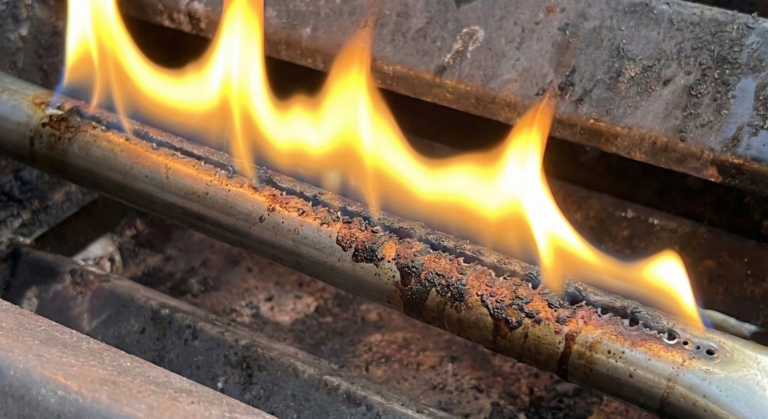
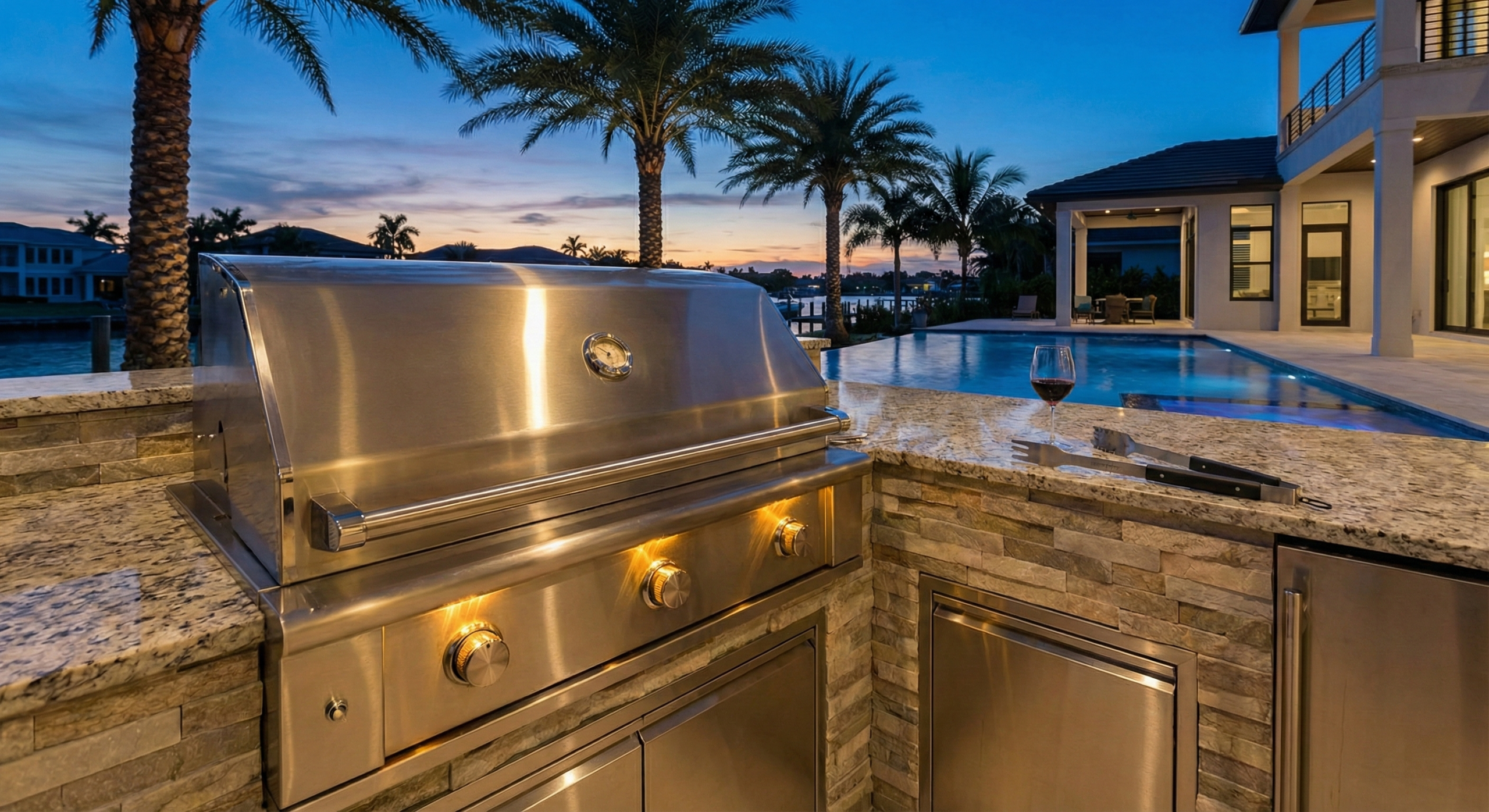
You have prepared prime steaks, invited family and guests to your outdoor patio, and fired up your premium grill—only to watch the hood thermometer stall at 250°F. The flames under the heavy cooking grids are feeble, fluttering yellow flickers instead of the roaring, uniform blue heat your luxury appliance was engineered to produce.
Most homeowners assume a weak flame simply means an empty propane tank or a loose connection. But when swapping cylinders changes nothing, ignoring the problem or attempting amateur repairs can trigger one of the most dangerous, destructive hazards in an outdoor kitchen: a flashback fire behind the front control panel.
If you hear a hollow roaring or whooshing noise from your grill, smell burning plastic or rubber, or notice heat radiating through the control dials, shut off the gas supply at the tank or shutoff valve immediately. Raw gas may be burning inside the front control cabinet directly against fuel lines and valves.
The Hidden Hazard: How “Flashback” Melts Your Grill from the Inside
A gas grill relies on a precise air-to-fuel mixture. Fuel shoots through micro-metered brass orifices and pulls in ambient oxygen through the burner air intakes before travelling into the main burner ports. When that airflow is restricted, gas cannot exit smoothly into the cooking box.
Instead, the gas mixture reverses direction—a phenomenon known in the gas industry as flashback. The flame actually leaps backward and begins burning inside the air shutter chamber, directly behind your front control panel. Because this area is concealed behind stainless steel fascias, homeowners often don’t see the fire until catastrophic damage has occurred:
- Melted Rotary Valve Seals: The intense localized heat bakes internal brass valve seats and neoprene seals, causing persistent, invisible gas leaks behind the knobs.
- Destroyed Ignition Wiring: 12V harness wiring, LED accent modules, and piezo igniter leads are quickly charred and short-circuited.
- Gas Line Rupture: Heat radiating into flexible stainless or rubber feed hoses can cause catastrophic line failure, turning a weak burner into a high-pressure firebox blaze.
Why Florida Coastal Insects Choke Burner Air Intakes
Why do burner air intakes clog in the first place? In South Florida’s humid climate, the primary culprit is biological. Yellow sac spiders and mud dauber wasps are instinctively drawn to ethanethiol—the chemical odorant added to propane and natural gas.
Insects enter the air intake openings on the underside of the burners and construct dense, moisture-resistant silk nests and egg sacs. These obstructions cannot be cleared by simply turning up the heat or blowing compressed air through the grates; in fact, attempting to ignite a choked burner forces gas into the control cavity, dramatically raising the risk of an internal fire.
The Dangerous Mistake: Poking Wire Into Soft Brass Orifices
When flames remain low and weak, many frustrated homeowners attempt a common online “hack”: sticking needles, paper clips, or copper wire into the small gas orifices behind the control knobs. On a precision luxury grill, this mistake is devastating.
Gas orifices are precision-drilled down to fractional thousandths of an inch to deliver an exact BTU rating. Forcing hardened steel wire into soft brass distorts the round bore into an irregular oval shape. Once enlarged, the orifice overfuels the burner, resulting in roaring yellow soot-producing flames, uneven heat, and permanent burner instability that requires full valve assembly replacement.
Manifold Pressure Drops and Dual-Stage Regulator Wear
In custom outdoor kitchens with multiple high-output burners (often demanding 75,000 to over 100,000 total BTUs), low heat is frequently caused by a failure in gas supply dynamics. Dual-stage regulator internal diaphragms stiffen and corrode in Florida’s salty air, restricting gas volume under heavy cooking demand even if static pressure seems normal.
Determining whether low flame is caused by an air intake obstruction, an internal valve leak, or a failing regulator requires specialized diagnostic equipment. Under Florida law, gas delivery systems must be serviced by certified professionals holding an active Florida Category V LP Gas Installer License (#LI100031).
Professional Diagnostic and Burner Restoration
At FL Grill Services, we don’t rely on guesswork or destructive wire tools. Our certified technicians perform comprehensive diagnostic procedures across South Florida luxury estates:
- Digital Manometer Pressure Testing: Measuring precise operating water column (W.C.) pressure across all burners under full demand.
- Complete Burner Throat Decontamination: Disassembling and clearing burner air intakes and channels without scratching precision surfaces.
- Electronic Gas Leak Detection: Sniffing internal rotary valves, manifold joints, and flex lines for micro-leaks caused by past flashback heat.
- Flame Calibration & Air Shutter Tuning: Balancing primary combustion air to restore crisp, roaring blue flames and maximum searing heat.
If your grill is struggling to get hot, producing yellow lazy flames, or making unsettling sounds behind the knobs, turn off the gas and protect your investment. Explore our luxury grill repair and diagnostic services or schedule an on-site evaluation backed by our 30-Day Workmanship Guarantee.
FL Grill Services Technical Team
FL Grill Services provides white-glove technical diagnostics, precision burner tuning, deep restoration, and certified fuel gas safety inspections for luxury outdoor kitchens across South Florida estates. All diagnostic and repair craftsmanship is backed by our 30-Day Workmanship Guarantee.